

Intro to
Quest Alliance
Quest Alliance is a non-profit that partners with 3,350+ institutions to equip youth with 21st-century skills, reaching 1.9 million learners and 27,500 educators through education technology and capacity building.
Team and role
Research & Design
with Anisha Bijur (Lead), Tanvi Maisheri & Rishiraj Charan (Product Design) - Project with NOCT, India
Industry
Education, Non-Profit
Goal
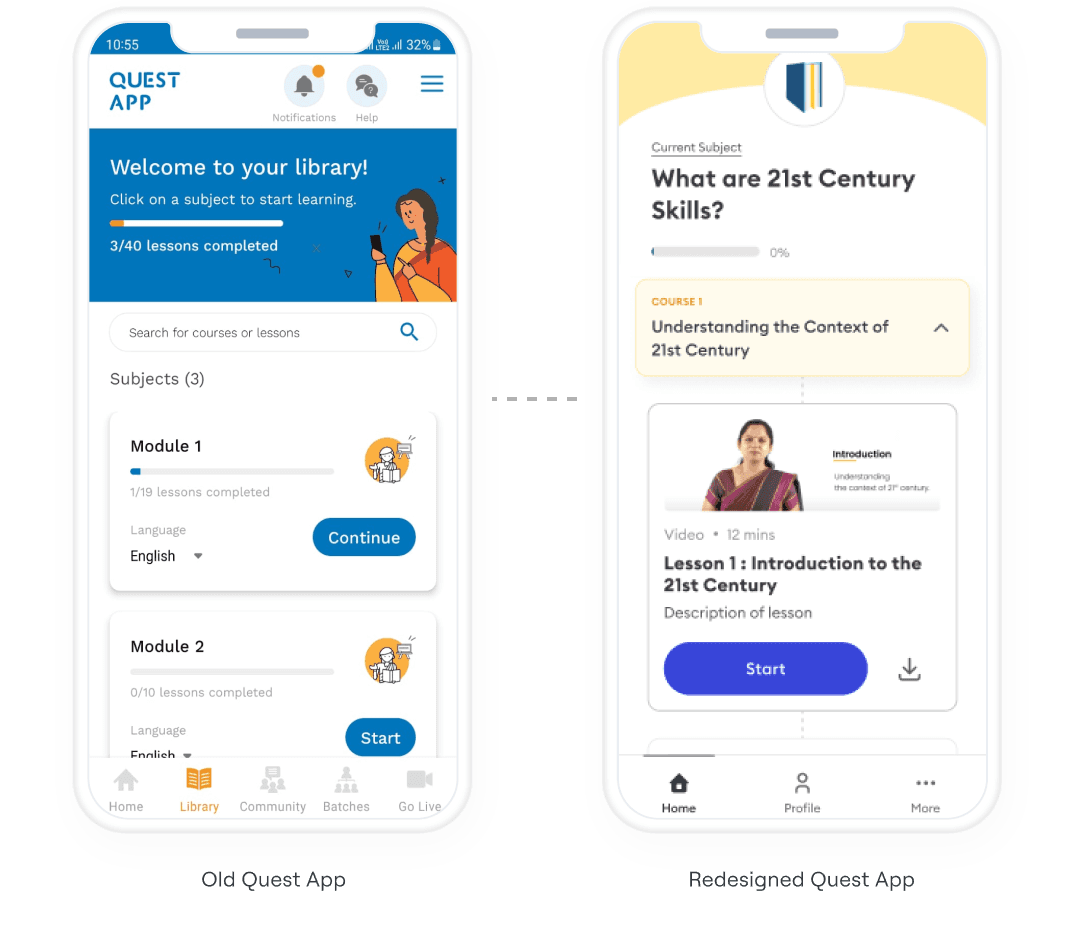
To address low engagement and lack of meaningful learning on the existing Quest App, a static content library, we redesigned it into a structured, self-driven learning experience.
Solution
Grounded in research, the new app reimagined the content flow, user journeys, and interface to support educator motivation, agency, and real-world application with a fresh visual upgrade.
Impact
A validated MVP that reframed the product's core experience and is now part of the case Quest Alliance is making to funders for the next phase of the program.
Redesigning the Educator Experience of the Quest App from the Ground Up
Phase 1 research surfaced insights the existing app had no way to act on, and new program requirements made a full redesign of the educator experience necessary. We ran an agile process to build the first MVP to hold up to funders, and give Quest a foundation to iterate on.

Key Considerations
FOR USERS
Keeping educators in the forefront. The core tension was giving educators real agency over their own learning while still providing enough direction that the path didn't feel aimless.
Tech limitations. Designed for a wide range of tech literacy and low-bandwidth conditions, leaning on interaction patterns educators already knew from apps like YouTube and WhatsApp.
FOR CLIENTS
Program needs. Quest's content had real depth that the product had to carry without complicating the learning experience and taking away agency.
Adaptability. Content and program needs would keep evolving after launch, so the structure had to flex for material that didn't exist yet without breaking what was already built.
Scale. Quest operates across the country with a large variation in the target audience behaviours and mental models. The learning goal remains the same, but pathways differ. The product needs to balance personlisation with ability to effectively and practically scale.
Designing the experience with the team, working with real end-user input
As Quest shaped new learning pathways and content, I worked closely with the Quest team to keep the app's UX aligned to the program's evolving goals.
Mid-fidelity wireframes were used as a thinking tool as much as a deliverable, giving us a shared surface to define content needs and shape user journeys before anything was locked.
We tested early prototypes with real educators to validate the core flows and content structure.
What worked:
Self-paced learning and goal-setting
Educators controlling their own learning journeys
Visual illustrations and personalization
What didn't:
Complex terminology and unclear copy
Disconnected recommendations
Confusing progress charts
Post-testing, I co-wrote the PRDs with the team to align design and content for the MVP, translating what testing surfaced into requirements Quest's content team could build against.

Final Solution
The New Quest App
A content library transformed into an engaging learning journey, designed to address exactly what research surfaced, so educators had a digital experience that genuinely supported them in building better learning environments in their own context.
Enabling educators to define and drive their own learning pathways.
Discovered Need
Educators engage more when their experience is acknowledged. They prefer self-directed learning, not being “taught to.”
Designed Solution
A baseline test personalized learning paths, empowering educators to guide their own journeys with minimal Quest support.

Sustaining engagement through a simplified, self-paced journey.
Discovered Need
Educators needed a learning experience that respected their time and fit around already full schedules.
Designed Solution
A self-paced, guided path with progress tracking and skip logic, keeping educators motivated, in control, and focused on what mattered to them.

Building a dynamic learning experience with varied content formats.
Discovered Need
Educators needed content that stayed engaging and manageable enough to prevent fatigue and sustain learning past the formal training window.
Designed Solution
Interactive lesson formats, stories, cards, videos, and quizzes, to ease cognitive load and keep motivation up across a full learning path.

Supporting real classroom application through hands-on practice
Discovered Need
Educators struggled to carry what they learned into their actual classrooms, with no built-in space for reflection, which limited how much of the training actually stuck.
Designed Solution
Activity and reflection modules built into the journey, giving educators a place to practice, document, and reflect on their teaching so the learning reinforced itself in the real world.

Design and illustration systems
UI and illustration style built for approachability
The visual language had to feel engaging and genuinely appropriate for adult learners, familiar without slipping into generic. Working closely with Adithi on the illustration direction, we shaped a style that stayed aligned with the product's tone and reinforced the ideas each screen was carrying.
The result, a clean, geometric vector style with expressive human elements, balanced professionalism with enough warmth to feel non-intimidating.

Laying the foundation of a design system
This MVP was built to be handed forward, not just shipped once. Design teams, LxD consultants, testing teams, and Quest's product and program verticals will all build on it going forward.
I structured the files and built a component library specifically so that handover, and the design system it points toward, would be fast to pick up and consistent to extend.

Reflections
Where this stands, and what's next
The redesigned Quest App and its MVP align content, user flows, and visuals with the educator needs research surfaced, on a foundation built to scale. It transformed a static resource library into an intuitive, guided learning experience with real contextual application, validated design decisions through direct testing with educators, and gave Quest a scalable design system for consistent UI/UX across future updates.

" transform="translate(1 1)" width="10px"/></g></g></svg>)
" transform="translate(1.5 1.5)" width="9px"/></g></svg>)
" transform="translate(3.75 3.75)" width="7.5px"/></svg>)